


Key Decisions & Iterations
Designing CharnMiles wasn’t linear. We began with strong assumptions about incentives, features, and channels, and tested each with users and stakeholders.

Directions for service features
Service Development
We co-created core artefacts that shaped CharnMiles:
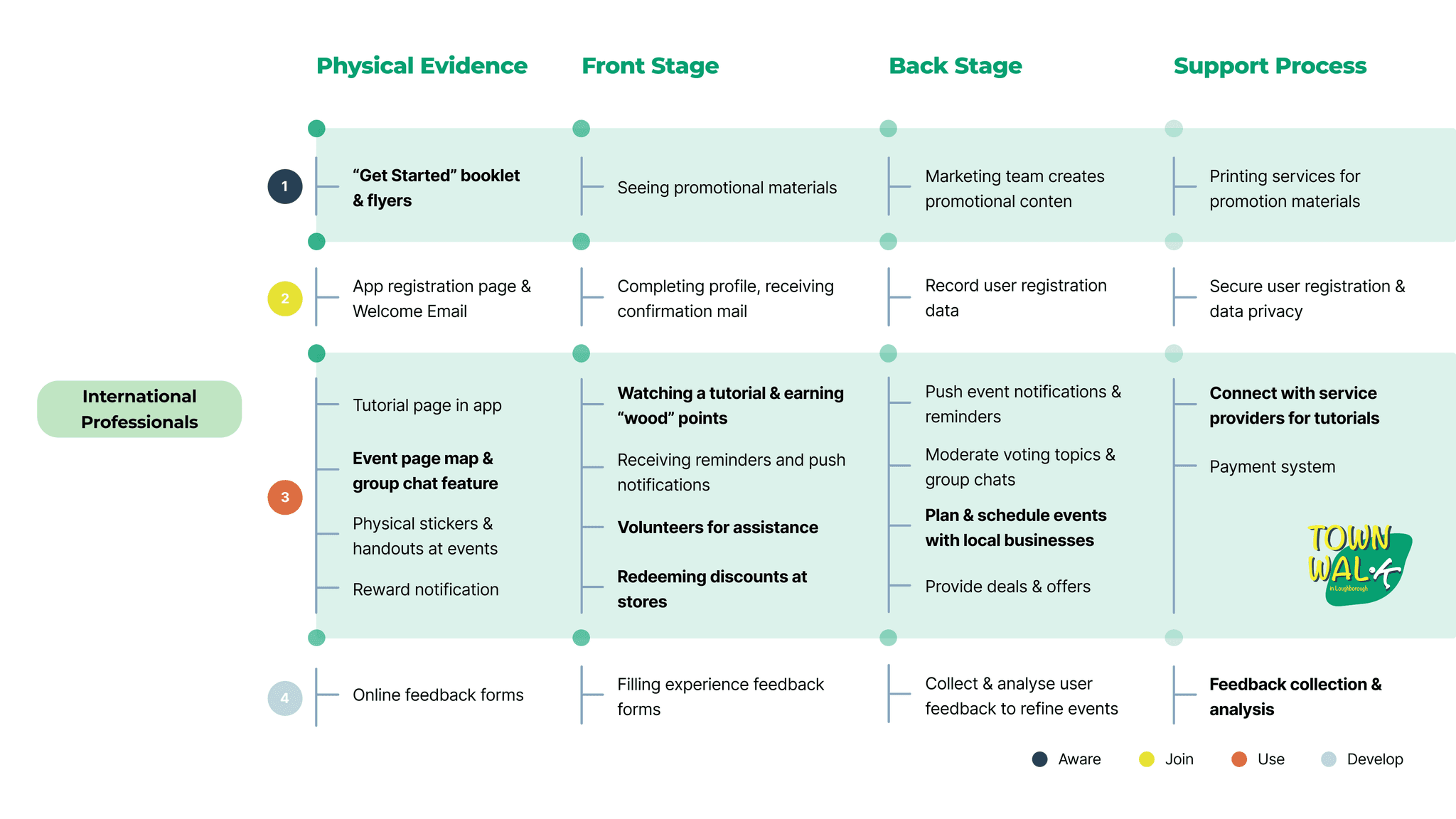
Service Blueprint: Clarified backstage roles across onboarding, walking events, and vendor engagement
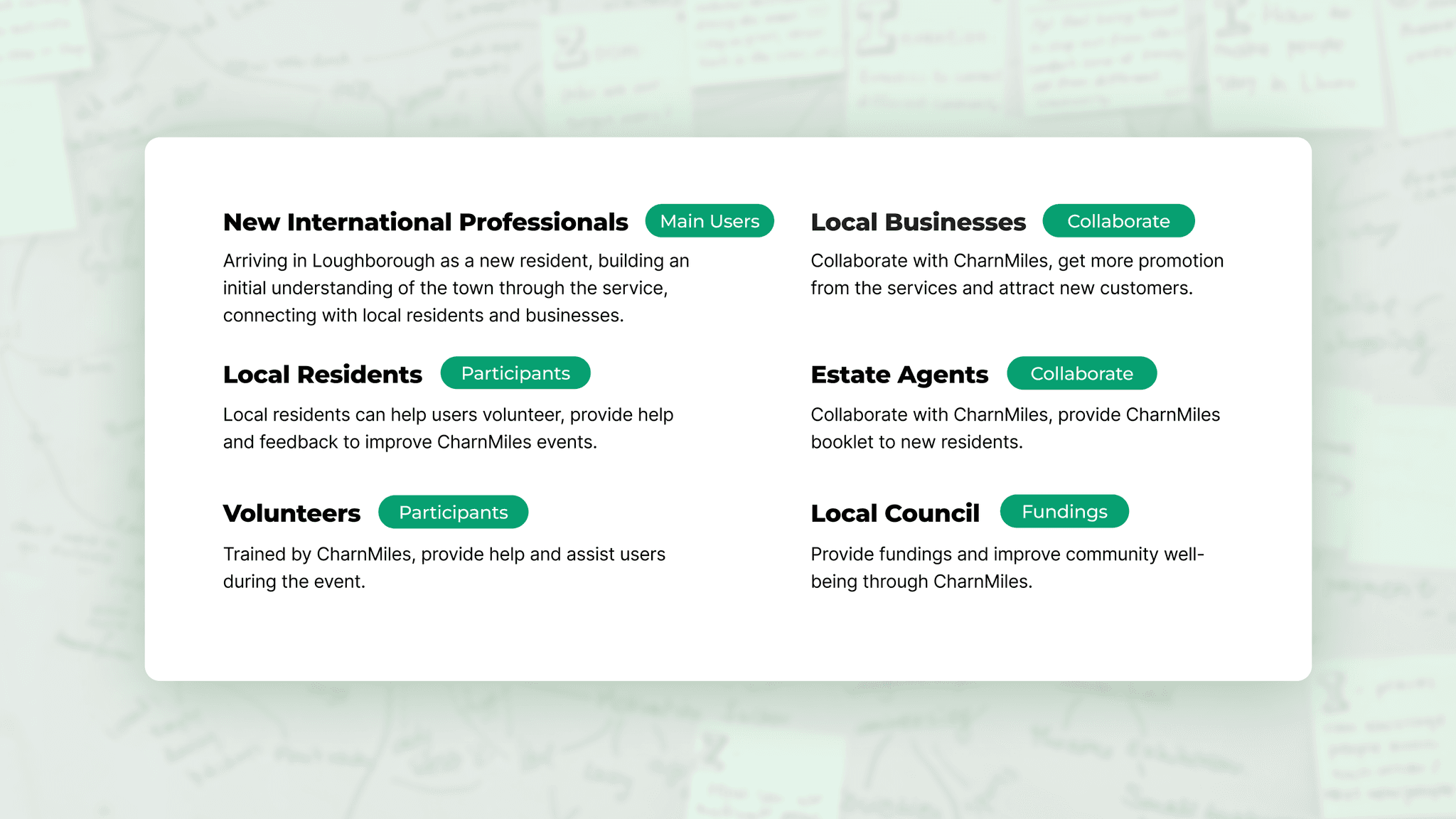
Stakeholder Map: Identified key actors — estate agents, volunteers, vendors, and local organisations
Future-State Map: Framed a scalable system for long-term engagement
This was where I realised service design shapes visible and invisible moments.

Stakeholder map
Service Thinking
We used service design tools like blueprints to uncover hidden frictions and align all actors involved. This helped us design not just for users, but for the entire system that supports them, turning ideas into experiences that can actually work.
Business Model Thinking
Alongside our service blueprint, we applied Business Model Canvas thinking to understand how CharnMiles could operate in the real world. This helped us think not just about designing the service, but sustaining it.

Business model canvas
Prototyping & Testing
We tested our assumptions through:
Storyboarding and user props (maps, stickers, flyers)
Bodystorming event flow with volunteers and local guides
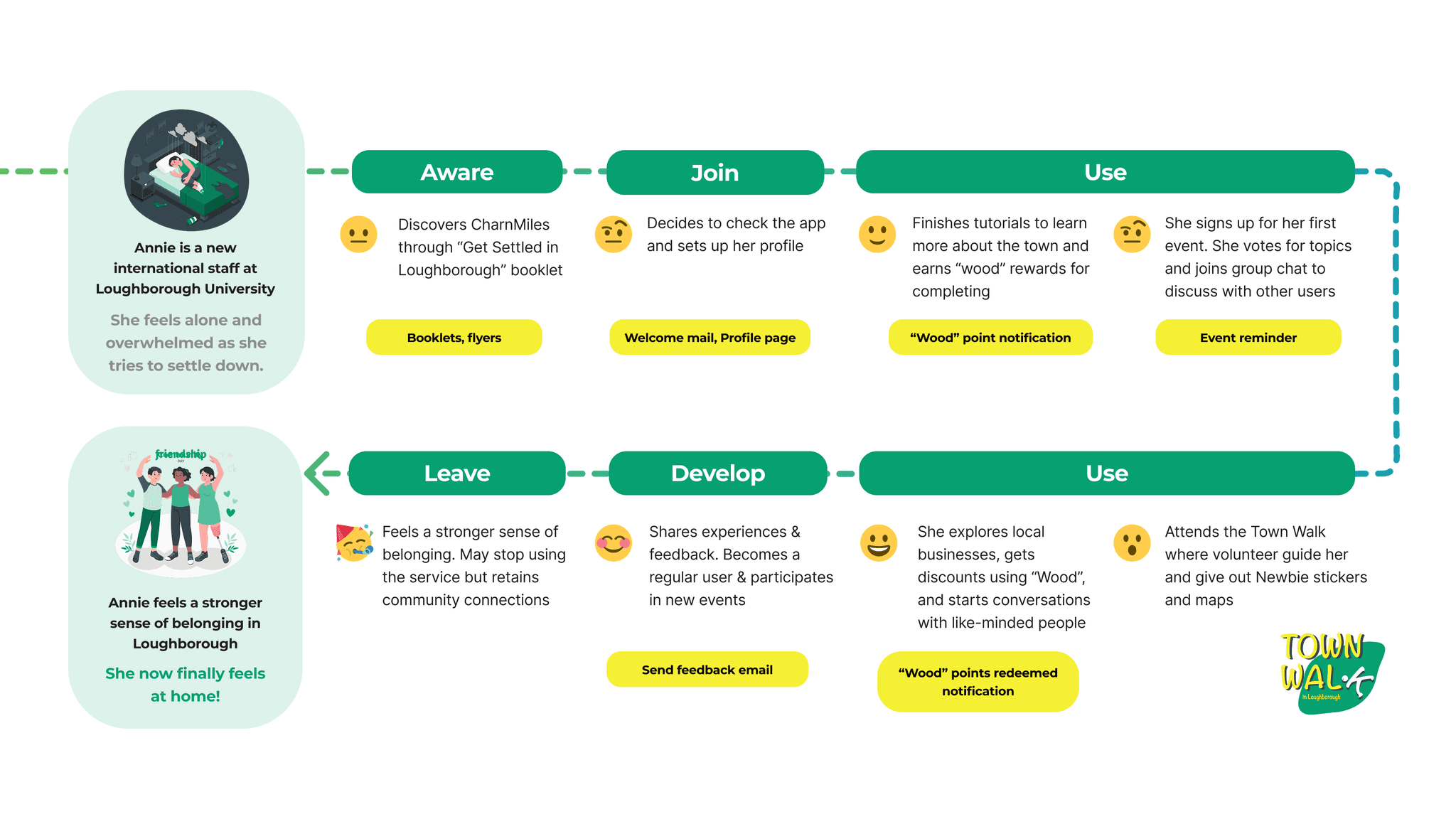
Scenario walkthroughs to simulate the onboarding experience
Key Insight: Residents were more likely to engage when invited by a person or place they already trusted, like estate agents or familiar volunteers.
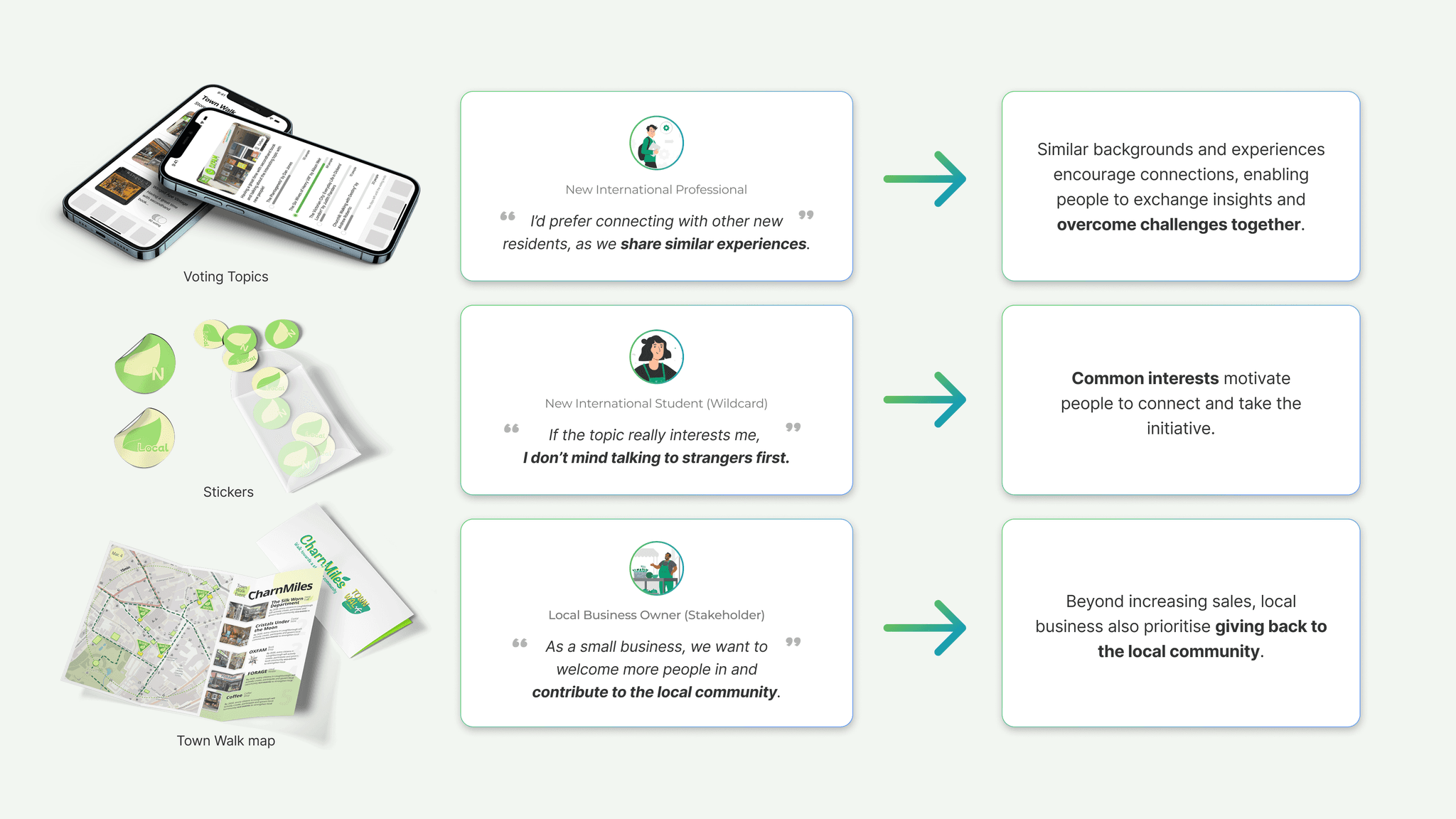
Insights from prototyping
Looking Ahead
" By 2030, every citizen in Loughborough will actively create, participate and govern local community eco-events to strengthen local community connections by knowing 50% of their neighbours. "
- CharnMiles future vision
CharnMiles was designed for Loughborough — but the challenges it addresses are shared by towns across the UK. Our long-term vision sees the service expanding first to neighbouring areas like Charnwood and eventually across Leicestershire, adapting to local context while maintaining its core principles of community-led onboarding and sustainable engagement.
To make this vision real, we identified four key uncertainties:
User Adoption – Will residents see the value early on?
Business Engagement – Will local vendors consistently support the model?
Sustainability – How might it sustain itself without grants or institutional backing?
Scalability – Can the service scale without losing its local authenticity?

Future road map
What I Learnt
This project deepened my understanding of designing for complex service ecosystems, where emotional, social, and logistical needs overlap. I learned that great service design isn’t about creating perfect features, but about building trust, timing, and relevance into the experience.
Through mapping, testing, and systems thinking, I developed a stronger grasp of:
Designing across touchpoints and stakeholders
Synthesising feedback into tangible service pivots
Making invisible support (like onboarding flows) feel intuitive and human
Each stage of the process reinforced that service design is as much about orchestrating relationships and expectations as it is about solving problems.
Reflection and Future Scope
A key limitation of this project was the lack of long-term, real-world testing. While early feedback shaped key decisions, we were unable to fully validate adoption and operational feasibility.
Future iterations should involve:
More diverse stakeholders, especially volunteers and local councils
Testing sustained engagement — would residents attend again?
Operational planning — how will this scale without losing local meaning?
With these in place, CharnMiles could grow into a replicable, community-first service that drives inclusion, sustainability, and local economic support, not just as a prototype, but as a real system of care.